AMD's HSMP driver gains new capabilities for Zen 6 EPYC processors, including finer power state control, enhanced thermal monitoring, and expanded DIMM management features.
The AMD Host System Management Port (HSMP) Linux driver is receiving significant updates to support the upcoming EPYC Zen 6 "Venice" processors, with new patches extending capabilities for system management and monitoring. The driver updates, sent to the Linux kernel mailing list, prepare for Family 1Ah Model 50h-5Fh support, which corresponds to AMD's next-generation server processors.
Enhanced Power State Control
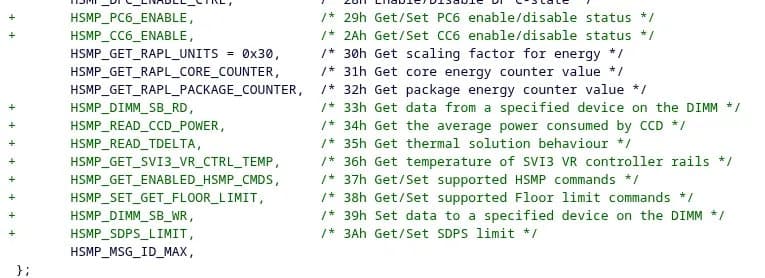
The most notable addition for system administrators is the new power state control functionality. The driver now supports Get/Set operations for PC6 and CC6 states (commands 0x29 and 0x2A), allowing finer control over processor power management. These capabilities enable administrators to enable or disable specific power states based on workload requirements, potentially optimizing performance-per-watt ratios for different server applications.
Advanced Thermal and Power Monitoring
Zen 6 EPYC processors will offer expanded monitoring capabilities through the HSMP interface:
- CCD Power Consumption (0x34): Direct reading of Core Complex Die power usage
- Thermal Delta (0x35): Tdelta readings for more precise temperature monitoring
- SVI3 VR Controller Temperature (0x36): Voltage regulator temperature monitoring
These additions provide server operators with granular visibility into power distribution and thermal characteristics across the processor, enabling more sophisticated cooling and power management strategies.
Expanded DIMM Management
The driver now includes support for DIMM sideband operations (commands 0x33 and 0x39), allowing administrators to get and set DIMM sideband data. This capability is particularly valuable for memory-intensive workloads where precise control over memory subsystem behavior can impact overall system performance.
Power Management Enhancements
New power management controls include:
- Floor Limit Control (0x38): Get/Set operations for minimum power state limits
- SDPS Limit Control (0x3A): Get/Set operations for Scalable Data Port Speed limits
These features provide additional levers for balancing performance requirements against power consumption constraints in data center environments.
System Capabilities Discovery
The addition of command 0x37 allows systems to query which HSMP commands are enabled, providing better compatibility detection and feature discovery across different EPYC processor generations.
Timeline and Context
The patches are currently under public review on the Linux kernel mailing list, with hopes they'll be included in the Linux v7.1 kernel cycle. This timing aligns with AMD's broader preparation for Zen 6 EPYC launch, which is expected later in 2026.
Beyond kernel support, AMD has already landed "znver6" compiler support in both GCC and LLVM/Clang toolchains, ensuring developers have the necessary tools to optimize software for the new architecture. The comprehensive approach to software enablement suggests AMD is positioning Zen 6 EPYC for a strong market entry with robust Linux ecosystem support.
The enhanced HSMP capabilities reflect the increasing sophistication of server management requirements, where fine-grained control over power states, thermal characteristics, and memory subsystems becomes critical for optimizing data center efficiency and performance.
Comments
Please log in or register to join the discussion