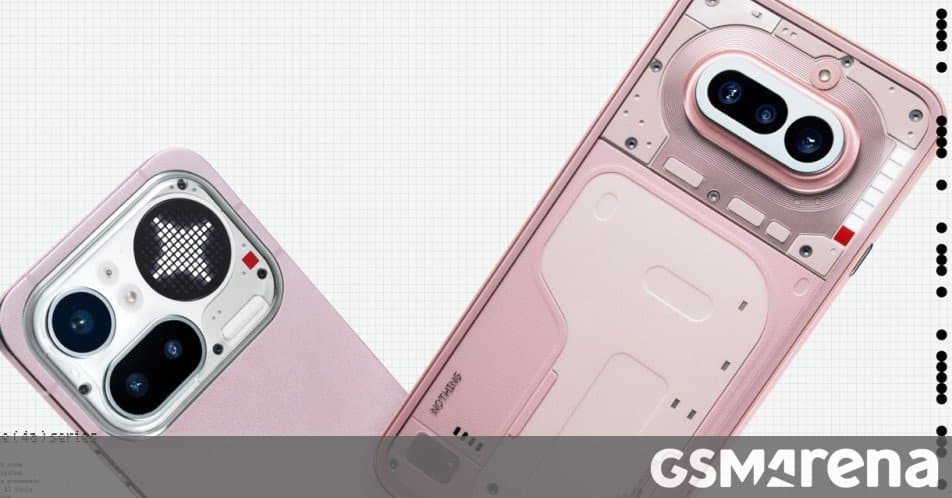
Nothing's new Phone (4a) series brings meaningful upgrades to the Pro model with a metal unibody, Snapdragon 7 Gen 4, and larger display, while the standard (4a) receives only minor camera and display improvements.
The Nothing Phone (4a) series has arrived with the company's latest design evolution, bringing notable changes to the formula established by last year's (3a) models. While the standard (4a) receives modest updates, the Pro variant stands out with significant hardware improvements.
Design and Build Quality
The Nothing Phone (4a) Pro drops the plastic frame of its predecessor in favor of a metal unibody design, measuring 7.95mm thin and weighing the same despite the material change. The phone carries an IP65 rating and features an unusual submersion claim of 25cm for 20 minutes, falling short of the typical IP67 standard's 100cm for 30 minutes.
In contrast, the Nothing Phone (4a) retains its plastic construction with a slightly thicker 8.55mm body and maintains the same IP64 rating with the 25cm submersion claim.
Performance and Hardware
The Pro model receives a substantial chipset upgrade to the Snapdragon 7 Gen 4, promising 27% better CPU performance, 30% improved graphics, and 65% faster AI processing compared to the 7s Gen 3 used in last year's models. It also features LPDDR5X RAM (8/12GB) and UFS 3.1 storage (128/256GB), with read speeds up to 147% faster than the previous UFS 2.2 standard. A 5,300mm² vapor chamber ensures sustained performance.
The standard (4a) gets the Snapdragon 7s Gen 4, which is technically newer but offers only a 7% performance increase and 10% better efficiency. It uses slower LPDDR4X RAM and lacks the vapor chamber cooling.
Display Technology
The Pro model features a 6.83" 144Hz OLED display with 1,260 x 2,800px resolution, protected by Gorilla Glass 7i and capable of 5,000 nits peak brightness with 2,160Hz PWM dimming. The standard (4a) has a 6.78" 120Hz OLED panel with 1,224 x 2,720px resolution, reaching 4,500 nits brightness and also protected by Gorilla Glass 7i.
Camera Systems
Both models share similar camera setups with some key differences. The Pro uses a 50MP Sony Lytia 700c main sensor (1/1.56") with f/1.88 lens and OIS, capable of 4K 30fps Ultra XDR video. The periscope camera features a 50MP Samsung JN5 sensor (1/2.75") with 3.5x OIS lens extendable to 7x with in-sensor zoom. Both include the same 8MP ultra-wide and 32MP front camera.
The standard (4a) swaps the main sensor for a 50MP Samsung GN9 (1/1.57") while keeping the same periscope, ultra-wide, and front camera hardware. However, it's limited to 1080p 30fps Ultra XDR recording, though it can do 4K 30fps without the enhanced colors.
Battery and Charging
Both models feature 5,080mAh batteries, with Indian variants getting 5,400mAh capacity. They support 50W wired charging and promise to retain at least 90% capacity after 1,200 charge cycles.
Glyph Interface Evolution
The Pro model introduces a Glyph Matrix with 137 LEDs arranged in a circular pattern, 57% larger than the Phone (3) and twice as bright at 3,000 nits. The standard (4a) features a Glyph Bar with 63 LEDs in a linear arrangement, 40% brighter than the (3a) at 3,500 nits.
Software and Availability
Both phones ship with Nothing OS 4.1 based on Android 16, promising 3 OS updates and 6 years of security patches. The Pro model launches in the US for the first time in the a-series, available in Black, Silver, and Pink, while the standard (4a) remains unavailable in the US market.
Pricing
Europe UK India US Nothing Phone (4a) 8/128GB €350 £350 ₹32,000 - 8/256GB €390 - ₹35,000 - 12/256GB €430 £400 ₹38,000 - Nothing Phone (4a) Pro 8/128GB €480 £500 ₹40,000 $500 8/256GB - - ₹43,000 - 12/256GB €550 £550 ₹46,000 $600
Pre-orders for the (4a) begin March 5 with sales starting March 13, while the Pro model's pre-orders start March 13 with sales beginning March 27.
Comments
Please log in or register to join the discussion