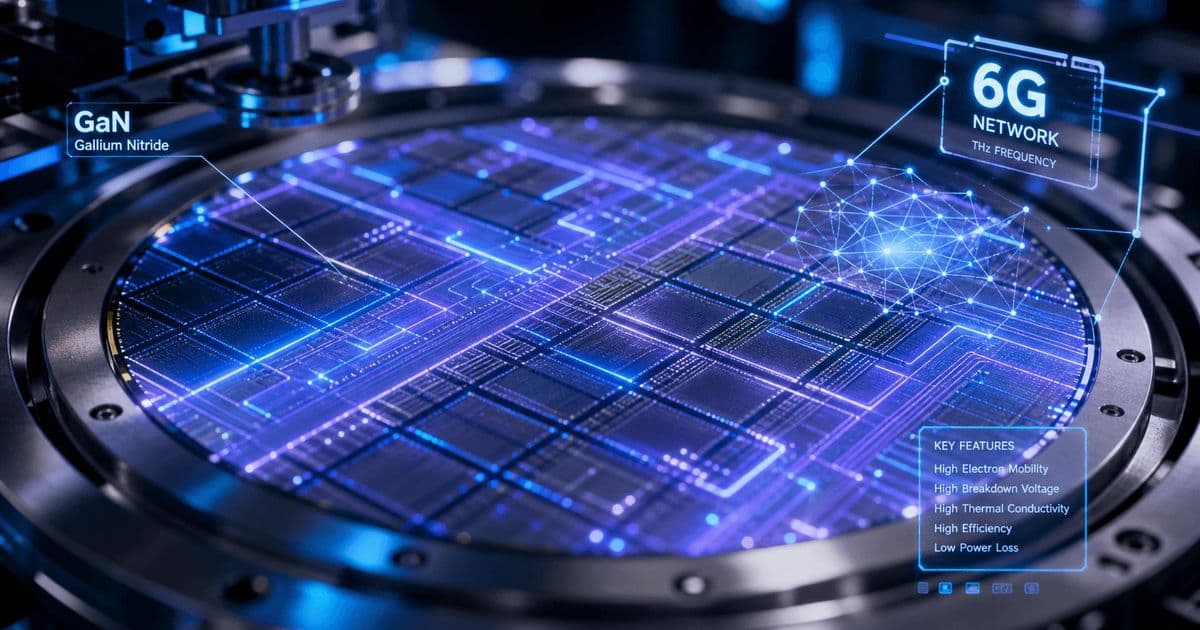
CETC-55 and Nanjing Guobo Electronics report delivering five million gallium nitride RF chips for space-air-ground network terminals. The volume is real and notable, but the announcement leaves the most important technical questions unanswered.
China's state-owned China Electronics Technology Group Corporation, through its No. 55 Research Institute (CETC-55) and partner Nanjing Guobo Electronics, says it has delivered five million gallium nitride (GaN) radio frequency chips for use in what it calls space-air-ground integrated network smart terminals. The figure was first reported by the South China Morning Post. If accurate, it marks one of the larger publicly disclosed volume runs of domestically produced GaN RF parts aimed at next-generation wireless hardware.
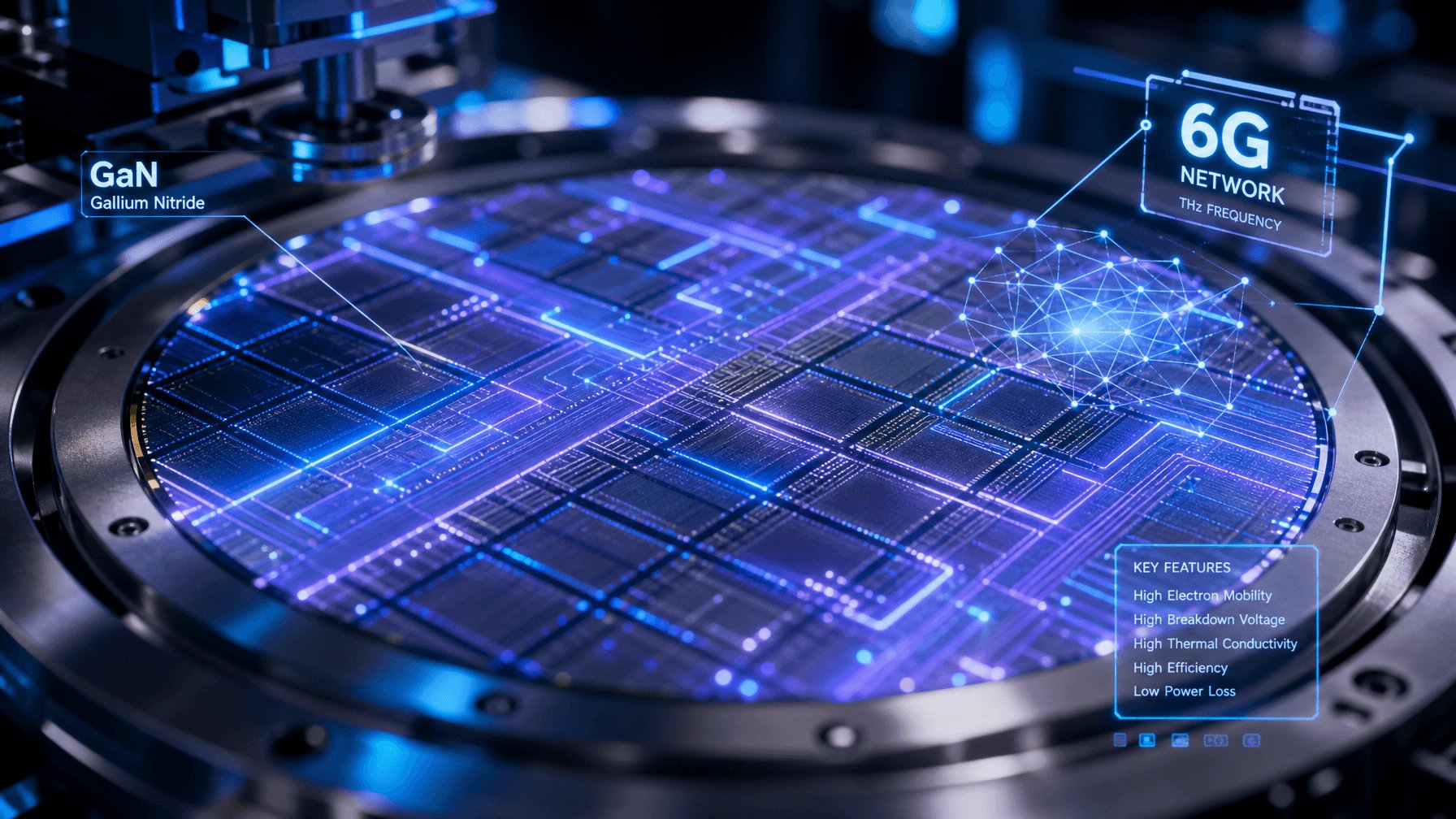
That is the claim. Before treating it as a turning point, it helps to separate what is genuinely new here from what is standard semiconductor marketing wrapped around a production number.
What GaN RF chips actually do
Gallium nitride is a wide-bandgap semiconductor. The bandgap of GaN is roughly 3.4 eV versus about 1.1 eV for silicon, which is the physical reason GaN tolerates higher voltages and higher junction temperatures before it breaks down. For radio frequency power amplifiers, the parts that drive the signal out of an antenna, that property translates into more usable output power per unit of chip area and better efficiency at high frequencies.
Silicon-based RF amplifiers run into a wall as you push into the upper microwave and millimeter-wave bands. They get inefficient and they heat up. That is why silicon laterally diffused MOSFET (LDMOS) technology dominated cellular base stations through 4G but started losing ground to GaN as 5G pushed into higher bands and demanded more power density. GaN on silicon carbide (GaN-on-SiC) has been the high-performance standard for years, used by companies like Qorvo and Wolfspeed. GaN on silicon (GaN-on-Si) is the cheaper variant, trading some thermal performance for lower substrate cost and compatibility with larger wafers.
The Chinese announcement specifically describes silicon-based GaN chips. That detail matters, and it is one the coverage glosses over. GaN-on-Si is the harder material system to make work well at RF because silicon's poorer thermal conductivity and the lattice mismatch with GaN create defects and heat-dissipation problems. Getting it to acceptable reliability at scale is a real engineering result. It is also the variant you would choose if your goal is cost and volume rather than absolute peak performance.
What is genuinely new, and what is not
GaN RF technology itself is not new. It has been in commercial radar, base stations, and defense systems for over a decade. So the substance of this story is not the material. It is the combination of three things: domestic Chinese design and fabrication, the silicon substrate, and the reported volume.
The five-million-unit figure is the headline, but a unit count alone tells you very little. A GaN RF "chip" can mean a single small-signal amplifier die or a complex multi-stage power amplifier module, and five million of the former is a far smaller achievement than five million of the latter. The announcement does not specify die size, frequency bands, output power, power-added efficiency, or yield. Those numbers are what an engineer evaluating these parts would ask for first, and their absence is the main reason to hold judgment.
What the report does claim, in general terms, is ultra-wideband support, high power, high efficiency, and reliability sufficient for aerospace and emergency communications. Every RF vendor claims those things. None of them are verifiable from a press statement.
The 6G framing is premature
The chips are pitched at 6G backbone infrastructure, commercial aerospace, the low-altitude economy, and emergency communications. The 6G label deserves skepticism for a simple reason: there is no 6G standard yet. The 3GPP standardization work for 6G is in early study phases, with a first usable release not expected until the end of this decade. Any chip described as "for 6G" today is targeting a moving and undefined specification. In practice these parts are more plausibly aimed at the satellite and non-terrestrial network (NTN) extensions already present in 5G, which is consistent with the analyst comment in the original report about supplementing satellite coverage where cellular signals are weak.
That application, direct-to-device satellite connectivity in handsets and field terminals, is the concrete and believable use case here. It is also an area of intense activity globally, from Apple's emergency satellite features to SpaceX's Starlink direct-to-cell work. A domestic Chinese GaN RF supply for these terminals fits the broader push toward semiconductor self-sufficiency under export-control pressure far better than it fits any literal 6G story.
Why the self-sufficiency angle is the real point
Strip away the next-generation language and what remains is a supply-chain development. China has faced sustained U.S. and allied export restrictions on advanced semiconductors and the tools to make them. RF and power semiconductors based on wide-bandgap materials are strategically important and have been subject to tightening controls. Building a domestic GaN RF pipeline that can produce millions of units reduces dependence on Western suppliers for a category of parts that goes into both commercial telecom and defense radar.
The CETC connection reinforces that reading. CETC is a state defense-electronics conglomerate, and its 55th Institute has a long history in compound semiconductors. A volume milestone from that institution is as much an industrial-policy signal as a commercial one.
The engineering work described, epitaxial growth, in-house chip design, process validation, and reliability qualification, is the full stack a country needs to control if it wants to make these parts without foreign inputs. That is the meaningful claim buried under the 6G headline: not that China invented something the rest of the world lacks, but that it is building independent capacity in a part of the supply chain that matters.
What to watch next
The useful follow-up questions are technical and economic. What frequency bands and output-power classes do these parts actually serve? Is the GaN-on-Si reliability data published or independently tested? What yield and cost do they achieve, since GaN-on-Si only makes sense if it undercuts GaN-on-SiC on price? And which shipping products actually contain them, because a delivery of five million chips to internal programs is different from design wins in commercial handsets.
Until those answers appear, the honest summary is narrow but not dismissive. A Chinese state-linked supply chain has reached volume production of silicon-substrate GaN RF chips for satellite and wireless terminals. That is a credible industrial step toward semiconductor independence in a strategically sensitive category. It is not, on the evidence provided, a 6G milestone, and it tells us nothing yet about how these parts compare to established GaN suppliers on the metrics that decide whether they win sockets in the open market.
Comments
Please log in or register to join the discussion