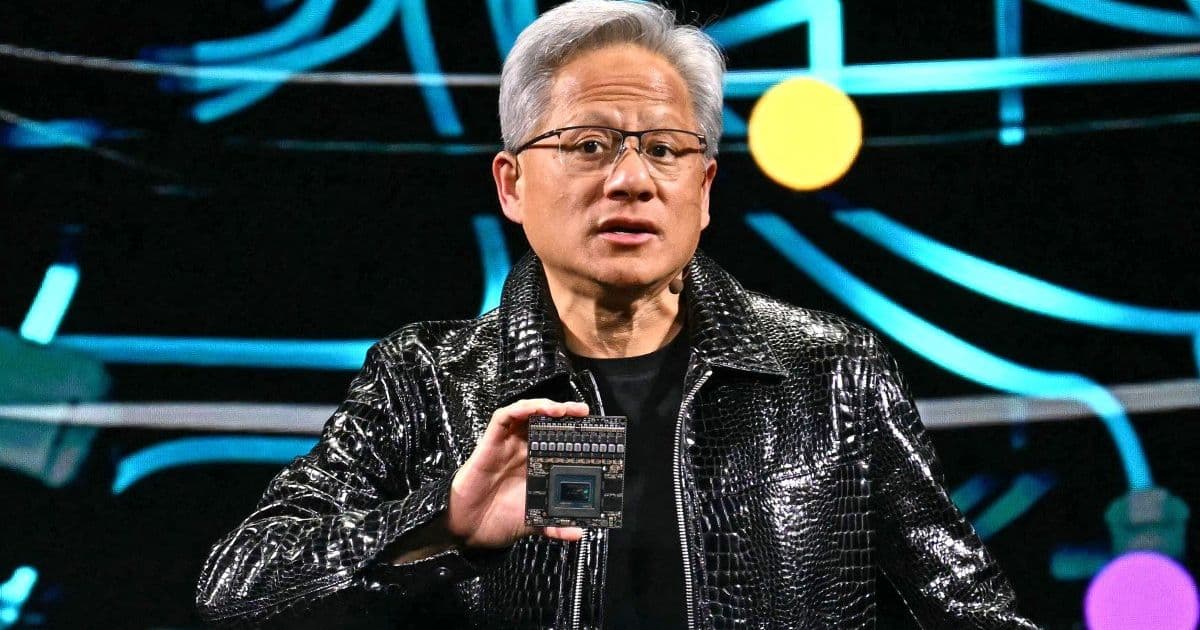
Nvidia CEO Jensen Huang's announcement that the company will likely make no further investments in OpenAI and Anthropic raises questions about the true motivations behind this pullback, especially given the increasingly complex and divergent paths these AI companies are taking.
Nvidia CEO Jensen Huang's recent announcement that the company will likely make no further investments in OpenAI and Anthropic has sent ripples through the tech industry, but his explanation raises more questions than it answers. Speaking at the Morgan Stanley Technology, Media and Telecom conference in San Francisco, Huang suggested that once these companies go public later this year, the opportunity for further investment would close. However, this reasoning seems to oversimplify the complex dynamics at play.
At first glance, Nvidia's position appears straightforward. The company is already minting money selling the chips that power both OpenAI and Anthropic's AI systems. Why would it need to pour even more money into these companies when it's already profiting handsomely from their success? When pressed for comment, Nvidia pointed to a transcript from its fourth-quarter earnings call where Huang stated that all investments are "focused very squarely, strategically on expanding and deepening our ecosystem reach."
But the circular nature of these arrangements suggests there might be more to the story. When Nvidia first announced its intention to invest up to $100 billion in OpenAI last September, MIT Sloan professor Michael Cusumano described it to the Financial Times as "kind of a wash," observing that "Nvidia is investing $100 billion in OpenAI stock, and OpenAI is saying they are going to buy $100 billion or more of Nvidia chips." This circular logic has led some to question whether these deals are creating an investment bubble.
The numbers tell an interesting story. The investment Nvidia finalized just last week as part of OpenAI's $110 billion round came in at $30 billion—well short of the earlier $100 billion pledge. This scaling back could indicate growing concerns about the sustainability of such arrangements.
Nvidia's relationship with Anthropic has been particularly fraught. Just two months after announcing a $10 billion investment in November, Anthropic CEO Dario Amodei took the stage at Davos and, without naming Nvidia directly, compared the act of U.S. chip companies selling high-performance AI processors to approved Chinese customers to "selling nuclear weapons to North Korea." This wasn't just a diplomatic faux pas—it was a direct challenge to Nvidia's business model.
The situation escalated dramatically in recent weeks. The Trump administration blacklisted Anthropic, barring federal agencies and military contractors from using its technology after the company refused to allow its models to be used for autonomous weapons or mass domestic surveillance. Within hours of that announcement, OpenAI said it had struck its own deal with the Pentagon—a move Anthropic has called "mendacious" and that the public appears to view similarly.
The market has already responded to this divergence. Within 24 hours of the back-to-back announcements, Anthropic's Claude shot to the top of the free-app rankings on Apple's U.S. App Store, overtaking ChatGPT. At the end of January, Claude was outside the top 100, according to Sensor Tower data.
Where does this leave Nvidia? The company now finds itself holding stakes in two companies that are pulling in very different directions, potentially dragging customers and partners along for the ride. Whether Huang saw any of this coming, given Nvidia's web of partnerships, is impossible to know.
His stated reason for likely pulling the plug on future investments—that the IPO window closes the door on this kind of deal—is hard to square with how late-stage private investing actually works. What's looking more probable is that this is an exit from a situation that has gotten really complicated, really fast.
As these AI companies chart increasingly divergent paths—one embracing government partnerships, the other maintaining a more cautious stance—Nvidia's strategic retreat may be less about timing and more about positioning itself to weather the coming storm of AI industry fragmentation.
Comments
Please log in or register to join the discussion