SpaceX has detailed AI1, its first-generation orbital data center satellite, which carries a 120 kW average compute payload that peaks at 150 kW across a wingspan wider than a Boeing 747-8. The vendor-agnostic chip design and a planned constellation of up to a million craft arrive three days ahead of SpaceX's IPO.
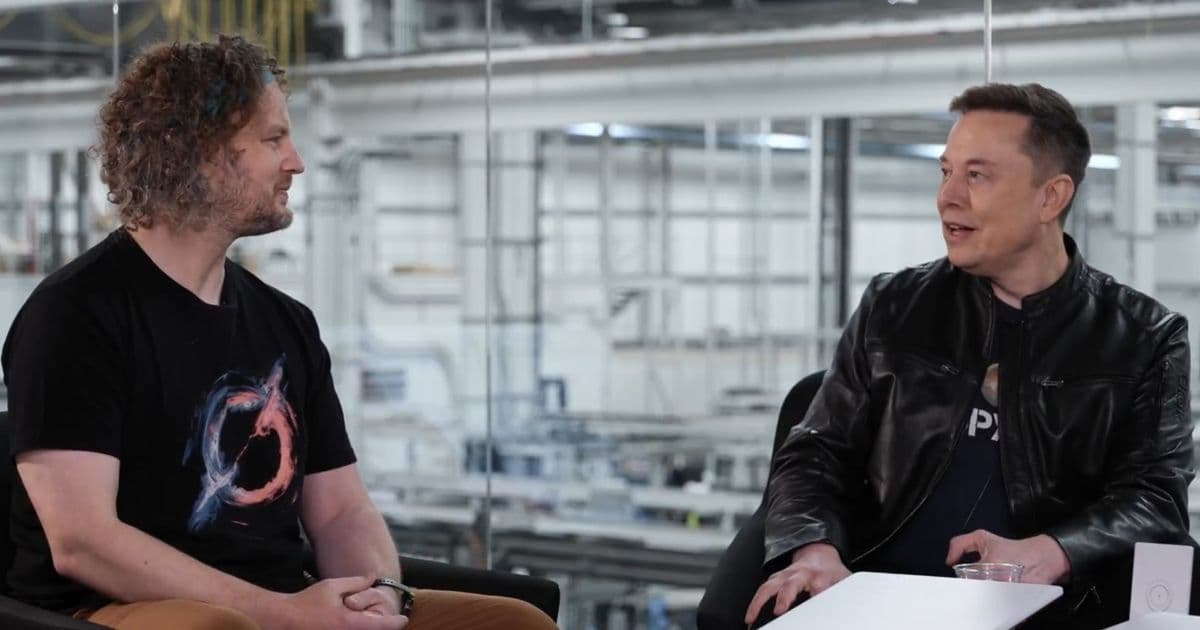
Elon Musk used a 30-minute video posted to SpaceX's X account to lay out the first detailed design of AI1, the opening generation of an orbital satellite built to run AI workloads off Earth's power grid. The headline figures: a 120 kW average compute payload, a 150 kW peak, a power density of 70 kW per ton, and a 70-meter deployed wingspan, all operating at roughly 600 km altitude. SpaceX wants to build these by the million.
The single most useful comparison Musk offered frames the whole project. He pegged the compute payload at roughly the draw of one Nvidia GB300 rack, which pulls around 140 kW on the ground. So one AI1 is, in rough terms, one rack in orbit. That sets expectations correctly. This is not a hyperscale facility folded into a satellite bus. It is a single high-density rack equivalent, flown above the atmosphere, multiplied across a constellation rather than packed into a building.
The hardware: interchangeable silicon and a 747-class span
The 70-meter deployed wingspan edges past the 68.4-meter span of a Boeing 747-8, which gives a sense of the physical footprint required to feed and cool a rack's worth of compute in space. Most of that area goes to solar collection and heat rejection rather than the compute payload itself.
The more strategically interesting choice is the interchangeable hardware design. Rather than soldering the platform to one supplier, SpaceX built the compute payload to accept processors from different chipmakers. That leaves the door open to whichever vendor ships the most competitive AI silicon at launch time, whether that is Nvidia, AMD, a custom accelerator, or SpaceX's own parts down the line.
That flexibility is not just good engineering hygiene. SpaceX cannot yet guarantee its own chip supply. The company is building Terafab, a fabrication plant running as a joint venture with Tesla, and its S-1 IPO filing explicitly warns that it cannot currently secure enough chips. An architecture that can absorb whatever silicon is available is a hedge against exactly that constraint. When your supply chain is uncertain, you design the socket to fit more than one part.
The cooling problem nobody can wave away
The central technical challenge is thermal. A rack on Earth dumps heat into moving air and circulating water. Neither exists in a vacuum. The only route to shed heat in orbit is to radiate it away as infrared, which is far less effective per unit area than convective or liquid cooling on the ground.
AI1 addresses this with up to 110 m² of deployable liquid radiators, redundant pumping loops, and integrated micrometeoroid shielding. The scale of the problem becomes clear against a known reference. The International Space Station's external thermal control system rejects roughly 70 kW of heat across 422 m² of radiator, at a cost of up to $500 million according to SemiAnalysis. That 70 kW is about half of what a single 140 kW GB300 rack needs. AI1 is claiming to reject more heat than the ISS using roughly a quarter of the radiator area, which is the figure most worth scrutinizing in the entire announcement.
Musk has dismissed thermal skepticism before, telling SpaceNews in March that it is "safe to say SpaceX knows how to do heat rejection in space" and pointing to the company's fleet of more than 10,000 Starlink satellites. Starlink units, however, run a tiny fraction of AI1's power budget, so the operational track record does not transfer cleanly. Radiator efficiency at these power densities is the open question that the published specs do not fully resolve.
Market implications and the IPO timing
The announcement timing is deliberate. It landed three days before SpaceX's IPO, set to price on June 11th and trade on June 12th at a target valuation near $1.75 trillion. A concrete orbital compute story, complete with signed customers, is exactly the kind of forward-looking narrative that supports a valuation of that size.
The demand side is not hypothetical. SpaceX filed with the FCC in January to launch up to a million orbital data center satellites and has already signed compute deals, including a reported $920 million-per-month agreement with Google. At a million craft each equivalent to one rack, the constellation would represent compute capacity on a scale that no terrestrial buildout could match within the same power and land constraints, which is the entire economic argument for going to orbit.
The model has serious detractors. OpenAI's Sam Altman called orbital data centers "ridiculous" earlier this year, and the skepticism is grounded in the same physics that makes the cooling claims hard to verify. Launch cadence, radiator performance at full load, and the chip supply gap that Terafab is meant to close all have to resolve favorably for the constellation math to work.

What AI1 establishes is a credible first design point rather than a finished product. The interchangeable silicon approach is a sensible response to a constrained supply chain, the power and density figures are specific enough to evaluate, and the cooling claims are aggressive enough to demand on-orbit proof. The next data point that matters is not another video. It is a flying unit holding 120 kW of compute thermally stable at 600 km.
Comments
Please log in or register to join the discussion