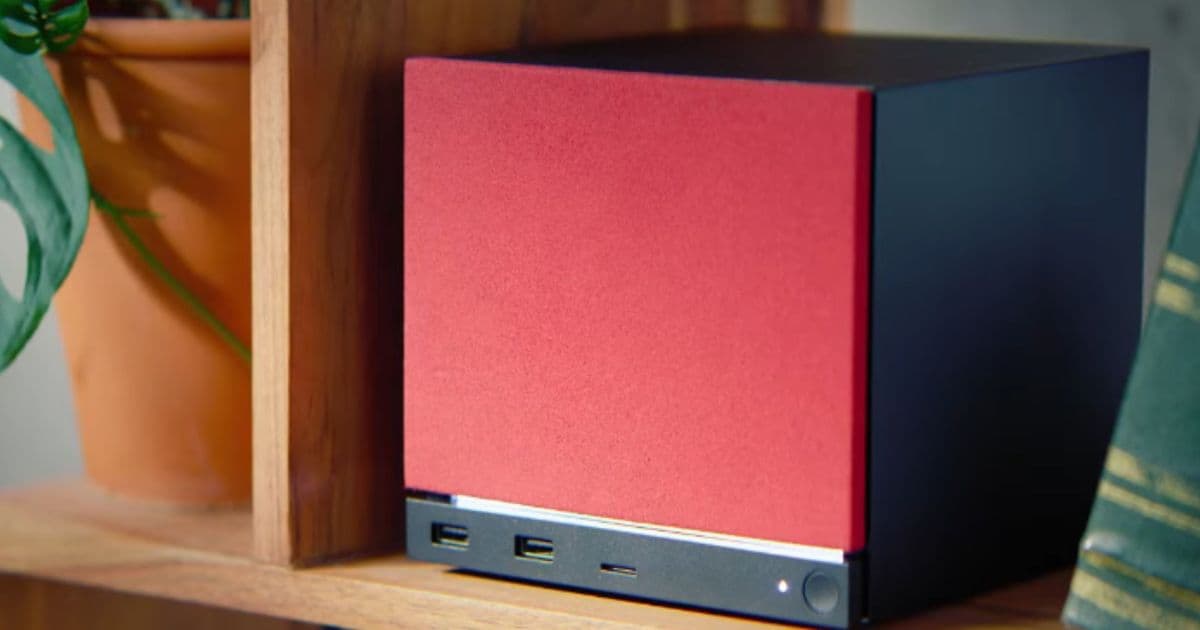
Valve still hasn't published specs for its upcoming Steam Machine, but a Reddit thread has pieced together a credible performance picture: roughly six times the Steam Deck, somewhere near a PlayStation 5, and built for 4K60 with the help of upscaling rather than brute force.
Valve's Steam Machine has spent the past few weeks generating debate over price and release timing. Now the conversation on Reddit has shifted to the question that actually decides whether this box is worth buying: how fast is it? Reddit user u/pimemento kicked off the latest round by asking whether Valve's living room PC can hang with current gaming hardware. The short answer, based on what Valve has confirmed and what the community has reverse-engineered, is that this is a competent 1080p-to-1440p machine that leans on software to reach 4K, not a high-end tower replacement.
What we actually know
Valve has been stingy with hard numbers. There is no published CPU model, no GPU die, no confirmed memory configuration. The one concrete figure comes from the "Steam Machine Verified" program, where Valve described the system as roughly six times more powerful than the Steam Deck. That is a useful anchor. The Steam Deck's custom Van Gogh APU pairs a 4-core Zen 2 CPU with 8 RDNA 2 compute units, and it targets 720p-class gaming at 15W. Multiply the graphics throughput by six and you land in a very different class of hardware, the kind that can drive a living room television rather than a 7-inch handheld panel.
Valve has also stated the system is designed for 4K at 60 FPS. That claim deserves a reviewer's skepticism, because "designed for" is doing heavy lifting. A 6x Steam Deck does not natively render Cyberpunk 2077 at 4K60 with the detail sliders maxed. It hits that target the way a PS5 does, by rendering at a lower internal resolution and upscaling, almost certainly through AMD FSR given Valve's RDNA history.
How it compares
The community consensus puts the Steam Machine near the PlayStation 5 in raw output, or just slightly below it. The PS5 currently sells for around $650, which sets a clear yardstick both for performance and for what Valve needs to charge. The most cited desktop comparison points are the Radeon RX 6600, the Radeon RX 6600 XT, and the GeForce RTX 4060. Those three cards bracket the 1080p-high to 1440p-medium tier well, and they line up neatly with the 6x Deck math.
Look at what those parts actually do in practice. An RX 6600 runs Cyberpunk 2077 at 1080p high in the 60 to 75 FPS range with FSR off, and a 1440p target becomes comfortable once FSR Quality is enabled. The RTX 4060 adds DLSS and better ray tracing, but the Steam Machine almost certainly uses AMD graphics, so FSR is the relevant upscaler. Alan Wake 2, one of the heaviest current releases, is the more honest stress test. On RX 6600-class hardware it needs upscaling and medium settings to hold 60 FPS at 1080p, and full path tracing is off the table. Expect the Steam Machine to behave the same way: smooth at 1080p and 1440p with medium-to-high settings, with native 4K reserved for older or lighter titles.
Memory is the other variable. Reddit estimates cluster at 16 to 32 GB of RAM. Sixteen is the practical floor for a 2026 gaming machine, and if Valve uses a unified memory pool shared between CPU and GPU, as consoles do, the higher figure becomes more important because the GPU carves out a slice for framebuffers and textures. A 32 GB unified setup would give the Steam Machine more headroom than a PS5's 16 GB GDDR6, which is one area where it could quietly pull ahead of the console it is being measured against.
Against a high-end gaming PC, there is no contest, and Valve clearly isn't trying to win that fight. An RTX 4080 or 4090 build runs in a different power and price bracket entirely. The Steam Machine's competition is the console under the television and the small-form-factor mini PC, not the enthusiast rig in the office.
Who it's for
The most clear-eyed point in the Reddit thread is that raw performance probably isn't the selling point at all. The pitch is the package: a device that boots straight into SteamOS, runs your existing Steam library without the maintenance overhead of a Windows gaming PC, and sits in the living room with console-like simplicity. That positioning targets the player who wants PC game compatibility and storefront access without building, updating, and troubleshooting a full desktop.
For that buyer, the hardware described here is enough. A machine that handles modern games at 1080p and 1440p with sensible settings, upscales to 4K for the television, and runs the entire Steam catalog through Proton covers the vast majority of real use. The people who need more already own a tower and a discrete GPU, and they were never the audience.
The deciding factors will be the two numbers Valve still hasn't given us: the final spec sheet and the price. If the Steam Machine lands near PS5 performance at a price that undercuts building an equivalent mini PC, it has a clear lane. If it arrives priced like a midrange desktop, the value argument gets harder, because at that point a standard PC offers more flexibility for similar money. Until Valve publishes the actual silicon, every performance figure here remains an informed estimate built on one official multiplier and a lot of community math. It is a reasonable estimate, but it is still an estimate, and reviewers will want hardware on the bench before calling it.
Comments
Please log in or register to join the discussion