
A new leak from veteran tipster Sonny Dickson reveals a high‑fidelity design model of Apple’s upcoming foldable iPhone Ultra. The prototype shows a single white finish, a round punch‑hole selfie camera on the inner display, and hints at the device’s dimensions, battery size, and upcoming A20 Pro chipset. The article breaks down what the visuals mean for Apple’s entry into the foldable market and who might benefit from the new form factor.
Apple’s long‑rumored foldable phone finally has a concrete visual reference. A design model posted by well‑known leaker Sonny Dickson offers the clearest glimpse yet at what the company is calling the iPhone Ultra. Below we unpack the most significant details, compare them with existing Android foldables, and consider which users will actually want this device.
What’s new in the leak?
White‑only chassis – The mock‑up is rendered entirely in a matte white finish. Earlier rumors suggested Apple might drop the traditional black option for its first foldable, and this image appears to confirm that strategy. A single‑color launch simplifies production and reinforces the premium, “first‑edition” vibe.
Round punch‑hole selfie camera – Unlike the Dynamic Island cutout seen on the upcoming iPhone 18 Pro, the inner display sports a classic, perfectly round punch‑hole. This mirrors the approach taken by most Android foldables (Samsung Galaxy Z Fold 5, Huawei Mate X 2, etc.) and suggests Apple is prioritising a clean, unobstructed viewing area for the inner screen.
Display sizes – The render shows a 5.5‑inch cover screen and a 7.8‑inch inner screen when unfolded. Those dimensions place the Ultra squarely between Samsung’s 6.2‑inch cover and 7.6‑inch inner panels, offering a slightly larger workspace without becoming unwieldy.
Hardware hints – The article cites expected specs: the 2 nm A20 Pro SoC, Apple’s largest‑ever iPhone battery (likely 5,000 mAh+), and a dual‑camera system without a telephoto lens. The omission of a telephoto module aligns with Apple’s recent trend of focusing on sensor‑size and computational photography rather than multiple focal lengths.
Software direction – Leaks point to a hybrid iOS/iPadOS experience, possibly dubbed iOS 27, that would automatically scale apps for the foldable form factor. This would be a departure from the current iPhone‑only UI and could bring multitasking features similar to iPadOS.
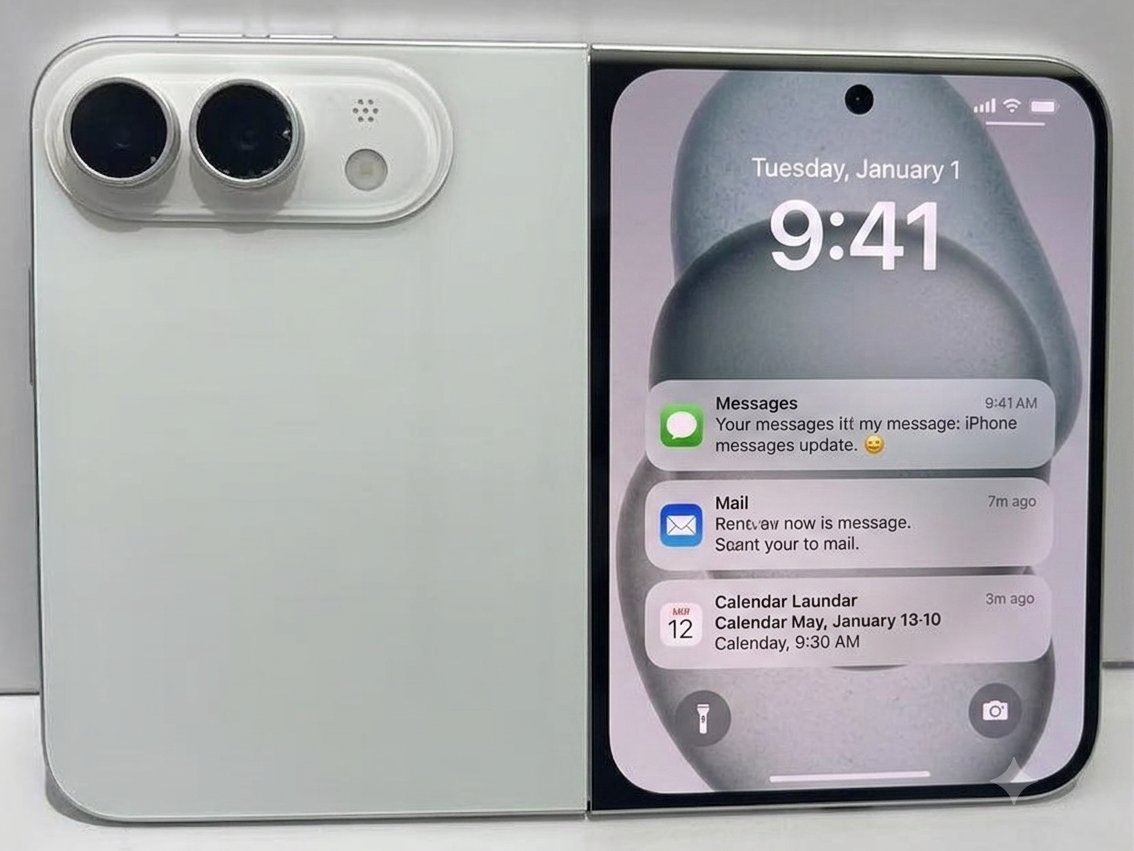
The design model of the foldable iPhone Ultra in white, showing the round punch‑hole selfie camera.
How does it compare to current Android competitors?
| Feature | iPhone Ultra (leaked) | Samsung Galaxy Z Fold 5 | Huawei Mate X 2 |
|---|---|---|---|
| Cover screen size | 5.5 in | 6.2 in | 6.45 in |
| Inner screen size | 7.8 in | 7.6 in | 8.0 in |
| SoC | A20 Pro (2 nm) | Snapdragon 8+ Gen 2 | Kirin 9000S (5 nm) |
| Battery capacity | ~5,000 mAh (rumored) | 4,400 mAh | 4,800 mAh |
| Camera layout | Round punch‑hole (inner) | Under‑display (inner) | Punch‑hole (inner) |
| Color options | White only | Black, Beige, Green | Black, White |
Apple’s advantage will be its A20 Pro chip, which promises higher single‑core performance and better power efficiency than the Snapdragon 8+ Gen 2. The larger battery should also give the Ultra a longer real‑world endurance than most Android foldables, which often struggle with the power draw of two high‑refresh displays.
On the downside, Apple’s decision to forgo a telephoto lens may disappoint users who expect the same camera flexibility they get on the iPhone 18 Pro series. Additionally, a single‑color launch could limit appeal in markets where black remains the default professional aesthetic.
Who is the iPhone Ultra for?
| User type | Why it matters |
|---|---|
| Power users who already own multiple Apple devices | The hybrid iOS/iPadOS UI will let them run iPad‑style multitasking on a phone‑sized chassis, making the Ultra a true productivity hub. |
| Creative professionals (photographers, designers) | The large inner screen offers a near‑tablet canvas for Adobe apps, while the A20 Pro ensures smooth performance for AI‑enhanced editing. |
| Apple ecosystem loyalists | A foldable iPhone eliminates the need to buy a separate iPad for larger‑screen work, keeping everything under one Apple ID and iCloud sync. |
| Tech enthusiasts | The novelty of a white‑only, punch‑hole foldable from Apple will be a collector’s item, even if the specs are only marginally better than high‑end Android rivals. |
| Budget‑conscious buyers | Likely not the target; the Ultra will sit at the top of Apple’s price ladder, probably north of $1,500, competing directly with premium Android foldables. |
What to watch for at WWDC
Apple’s WWDC starts in a few hours, and analysts expect a software preview rather than a full hardware reveal. If Apple does showcase iOS 27, we’ll likely see:
- Dynamic scaling – Apps designed for a single‑screen iPhone will automatically expand to fill the inner display when unfolded.
- Enhanced multitasking – Split‑view and slide‑over modes similar to iPadOS, possibly with a new “Foldable Dock” for quick app switching.
- Face ID adaptation – The round punch‑hole suggests Apple will retain the current Face ID system, but we may see a refined algorithm to work across both screens.
Bottom line
The leaked design model gives us enough concrete data to say Apple is taking a conservative but confident approach with its first foldable. By opting for a single white finish, a familiar round punch‑hole camera, and a hybrid iOS/iPadOS experience, Apple aims to attract its existing high‑end user base while testing the waters of a market still dominated by Android.
If the rumors hold, the iPhone Ultra could set a new benchmark for performance and battery life in the foldable segment, even if it doesn’t push the envelope on design variety. Expect the device to launch alongside the iPhone 18 Pro series in September, with pricing that reflects its premium positioning.
Sources: Sonny Dickson’s leak on Twitter, Notebookcheck internal analysis
Comments
Please log in or register to join the discussion